Japanese Gameboy Micro Faceplate (Concepts?)
Nintendo Japan has a flash app that shows 160 faceplates for the micro. Judging from the lack of a finished feeling to most of them, I’m assuming these are concept art or contest entries.
This one is a neat idea – imagine getting a custom-drawn, signed faceplate from your favorite artist!

More here.
Nintendo DS Homebrew WIFI Progress
Stephen Stair say’s it’s smooth sailing from here on out on his WIFI project. We’re all rooting for you, man!
| Field of work | Completion Level |
| Receiving data: | 100% |
| Transmitting data: | 85% |
| Interrupts/Data Queuing: | 95% |
| arm7/arm9 communication structure: | 100% |
| 802.11b implementation (arm7): | 85% |
| TCP/IP [integrating lwIP] (arm9): | 20% |
| API for other wireless functions (arm9): | 90% |
Gameboy Micro Faceplates that light up!!!
OK, I picked up a Japanese Gameboy Micro tonight at Network Video in Burlingame, CA.
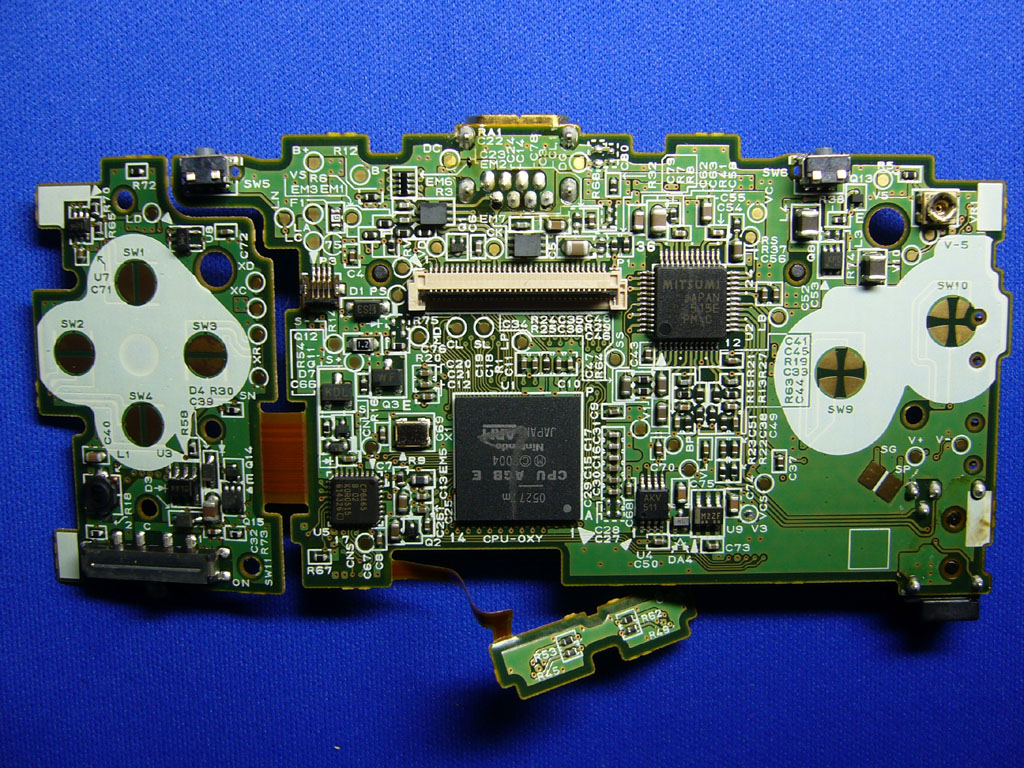
There is a jack accessible to the faceplate (under the faceplate, above the a button) that says V-5(5 volts, I assume) on the circuit board.
Questions: When will Nintendo or Third Parties release Smart Faceplates? Where can I buy a plug for the jack shown on this image(upper right hand corner)? [image is from this set of photos]
Update: Here’s a pic of the micro without a faceplate. The jack is above the a button –

Update: I haven’t been able to get a reading on the jack. The connection is really small, so I’m having trouble getting a clear shot at it with my multimeter. Meanwhile, my triwing(Nintendo uses ‘tamper-proof’ screws to keep us out) screwdriver isn’t working on the super small screws on the micro, so I can’t test the connections on the board, yet.
Update(9/26/05): I ordered a new triwing screwdriver yesterday. Hopefully it will arrive soon and will be small enough to open the case.
Update(9/26/05): Discuss at gbadev’s forums.
Update(9/26/05): Discussion at WarpPipe
Update(9/28/05): It turns out that my triwing screwdriver IS small enough to work on the micro’s screws. I just had to push hard enough while turning. I disassembled it and tested the leads heading into the connector. There is definitely 1.7 volts headed into the connector, but I still haven’t been able to get a reading from the jack itself. I now have some homemade test leads that are probably thin enough and I’ll try again tonight.
Update (9/28/05): Just tested with my new thin leads. There is no power coming from the strange jack.
 John Tokash